
GS1 Digital Link: The 2D Barcode Standard Behind Sunrise 2027
Reviewed by Andrew Verb, Bar Code Graphics, Inc.
By the end of 2027, retailers are expected to scan 2D barcodes at the point-of-sale under GS1’s Sunrise 2027 initiative. The GS1 Digital Link standard is what makes this possible: a single QR code that scans at checkout and also connects the product to the web by embedding a web address instead of just a number. For 50 years UPC barcodes have been integral in supply chain processing — Digital Link extends them to strengthen brand engagement, traceability, patient safety, and supply-chain efficiency.
The educational information below is geared to provide an overview of this exciting new initiative. Technical resources are provided in the right column. Essentially, the Digital Link format allows a single 2D barcode to provide point-of-sale functionality and also behave as a consumer-facing web-based URL to enhance a consumer experience. With the December 2027 deadline approaching, it is imperative that companies understand the importance of how they assign their GTINs and manage their product information today so they can take advantage of this new initiative.
Today’s consumers are scanning products using their smartphones to research what they want to purchase or to learn about what they have just bought. Due to a lack of standardization and control, mobile scans from UPC barcodes typically yield unreliable and inaccurate results. To address shoppers’ need for more information, some manufacturers have begun by adding QR codes on packages that connect consumers to more product information. Although these barcodes direct consumers to content curated by the brand, these additional symbols take up valuable “real estate” on packages and labels. Furthermore, the additional barcodes are causing confusion when scanning at point-of-sale checkout counters.
Consumer Experience – GTIN Digital Link

As online shopping has proliferated over the past decade, consumers have become accustomed to making selections from online content. Information ranging from ingredients, recipes, customer reviews, and recalls is part of the new decision-making process. Using the GS1 Digital Link, consumers can now use their smartphone (no specific app required) to scan a QR code on the package which directs them to a brand-owned web page that provides the information they now expect.
The structure of the GS1 Digital Link is also designed to direct different applications to read the same barcode but direct the user to a completely different web destination. Consequently, the same consumer who reads the QR codes in the store can have completely different experiences scanning the same code with different 3rd party applications.
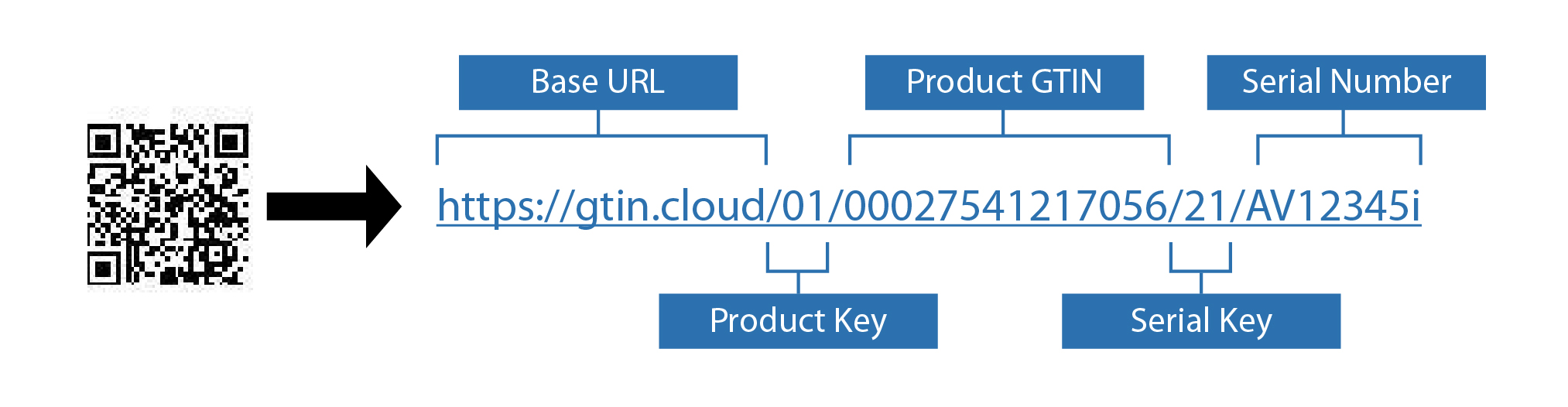
These “experiences” can be ordering products, collecting loyalty points, and posting on social media sites. See our GTIN Digital Link overview for more details about how this functionality works. Whereas the term “GS1 Digital Link” addresses the global schema for encoding the data, the term for the connecting barcode is called a “GTIN Digital Link”.
Healthcare experience
The information provided by pharmaceutical manufacturers is often intimidating to consumers. Aside from small dense printing which is challenging to navigate, the information is commonly provided in multiple languages. Not only are the information leaflets expensive to produce, but they pose ecological problems with the amount of wasted paper. By using the “resolver” component of the Digital Link, mobile applications can allow users to scan on-pack GTIN barcodes and be redirected to an electronic patient information leaflet which, through a simple setting in their smartphone, is delivered in their preferred language. Learn more about how resolvers work in our GS1 Digital Link FAQ.
Supply chain
Product data management is crucial for both retailers and manufacturers. Suppliers are often forced to use complex data-sharing ecosystems to collate images and video from a content service provider, marketing material from a digital agency, and perhaps multiple sources of data covering logistics and product information—an expensive, duplicative, and time-consuming process. Leveraging GS1 Digital Link and resolver technology, the industry can enable a future product-listing process—one that uses foundational GS1 identity to streamline and connect trading partners to relevant, brand-authorized sources of data. Traceability solutions may also be greatly enhanced by the use of the same GS1 Digital Link barcode. GS1 Digital Link enables the identification of specific product batches (or even serialized products). This additional data in the barcode can support linking to information about provenance, recall, and/or expiry. Retailers can save a significant amount of time—and avoid losing revenue and brand trust—by quickly locating and removing products from shelves more precisely.
The Obvious Question – Is the UPC barcode going away?
The short answer is not in the near or immediate future. There are many technological and behavioral challenges that will need to be addressed before the UPC barcode rides off into the sunset. It is important to note that this initiative does put an enormous spotlight on why companies need to correctly identify their products with compliant GTINs and take control of their associated product data. Read our Sunrise 2027 guide to learn more about the transition timeline and the hurdles the Digital Link has to overcome.
Click Here to Learn More About The Digital Link
As the US barcode authority, we have created tens of millions of barcodes currently found on consumable products, books, and coupons. We support the Digital Link transition with a free online validator, printed QR code testing and grading, and training. Our specialized web services provide .eps barcodes and we anticipate forging partnerships directly with brands so they can dynamically interface to our barcode creation web services to eliminate data entry. Please contact us at sales@barcode.graphics for assistance and information click on the chat button below. UPC barcode mistakes can be quite costly if not properly implemented. With your company’s success on the line, it is important to properly identify your products.
